
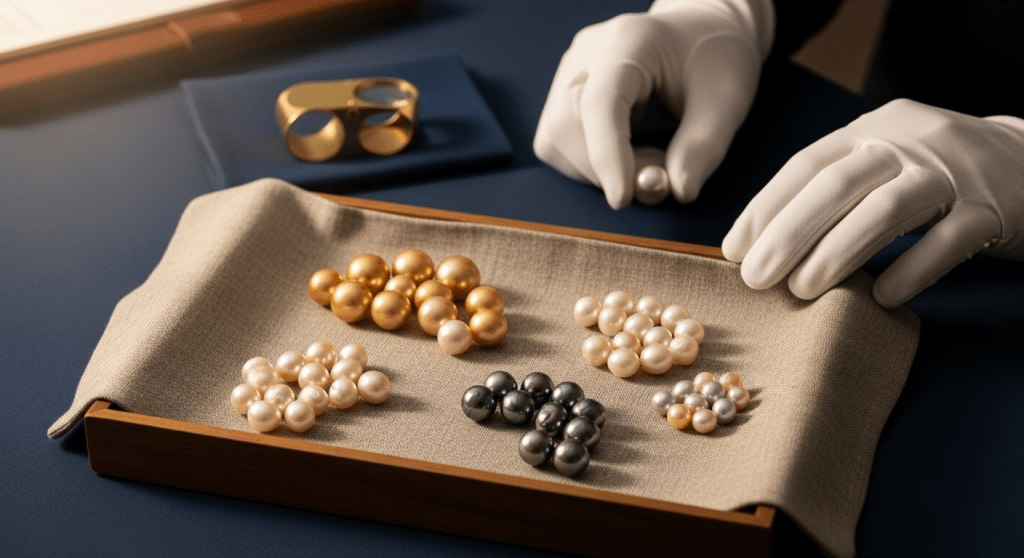
The Basics: How Pearl Color Forms
Pearls dazzle with their natural colors—white, gold, black, pink, lavender—all thanks to the oyster or mussel that creates them. Mastoloni’s expertise in sourcing from the world’s finest oysters brings you this spectrum of elegance.
The color of a pearl comes from the layers of nacre an oyster deposits around a nucleus. Bodycolor, overtone, and orient—terms that describe the pearl’s base shade, subtle surface tint, and shimmering iridescence—are all shaped by the oyster species, the surrounding water, and the mollusk’s diet.
Nacre Thickness Shapes the Luster & Depth of Color
- Thicker nacre = deeper, richer colors and longer-lasting beauty.
- Thinner nacre = brighter but more delicate surface appearance.
Educating customers about nacre thickness (especially with Akoya pearls) helps them understand why quality pearls command a higher price — and why Mastoloni pearls are graded for excellence.
Overtone vs. Body Color vs. Orient
- Body Color: The base hue of the pearl (e.g., white, gold, black).
- Overtone: A translucent color overlay — rose, silver, or cream for Akoya; green or aubergine for Tahitian.
- Orient: The rainbow-like shimmer caused by light interference in nacre layers.
Retail Tip: Showing customers two pearls of the same body color but different overtones side-by-side is an easy way to spark an “I didn’t know pearls could do that!” moment — and often leads to a sale.
Key Oyster Species & Their Pearls
- South Sea (Pinctada maxima): Gold-lipped oysters yield pearls in gold and champagne hues, while silver-lipped oysters create white and icy silver pearls.
- Tahitian (Pinctada margaritifera): Black-lipped oysters from French Polynesia produce Tahitian pearls, famous for their dark greys, greens, and prized “peacock” overtones.
- Akoya (Pinctada fucata martensii): Known for classic round pearls, the Akoya oyster creates pure white and creamy pearls, often with rose or silver overtones.
- Freshwater Mussels: Mainly from China, freshwater pearls span white, pink, peach, and lavender, with diverse shapes and luster.
Why This Knowledge Sells
- Builds trust: Customers see you as an expert, not just a salesperson.
- Supports upselling: Explaining why a deep golden South Sea pearl is rarer than a silver one justifies its price.
- Adds story value: Buyers connect more when they understand the journey from oyster to showcase.
Conclusion
Pearl color isn’t random — it’s a combination of species, nacre thickness, and nature’s artistry. By sharing these details with your customers, you transform a beautiful accessory into a piece of living ocean history… and a treasured sale.
Discover “The Most Beautiful Pearls in The World.” To elevate your retail collection, contact us to schedule a private showing of our full Mastoloni color range — from shimmering Akoya to rare golden South Seas.


 Anthony The Pearl Guy
Leave a comment